


Harnessing the power of super-heated steam unlocks extraordinary benefits for growers seeking healthier growing substrates, soils and stronger crops. By steam treating growing spent substrates at 85°C with Stronga’s FlowSteama and SteamBoila technology, harmful pathogens are suppressed while beneficial microbes are allowed to thrive.
The controlled, highly effective FlowSteama approach creates a fertile, nutrient-rich environment that plants can exploit, resulting in faster propagation and establishment, vigorous growth, and a resilient microbiome.
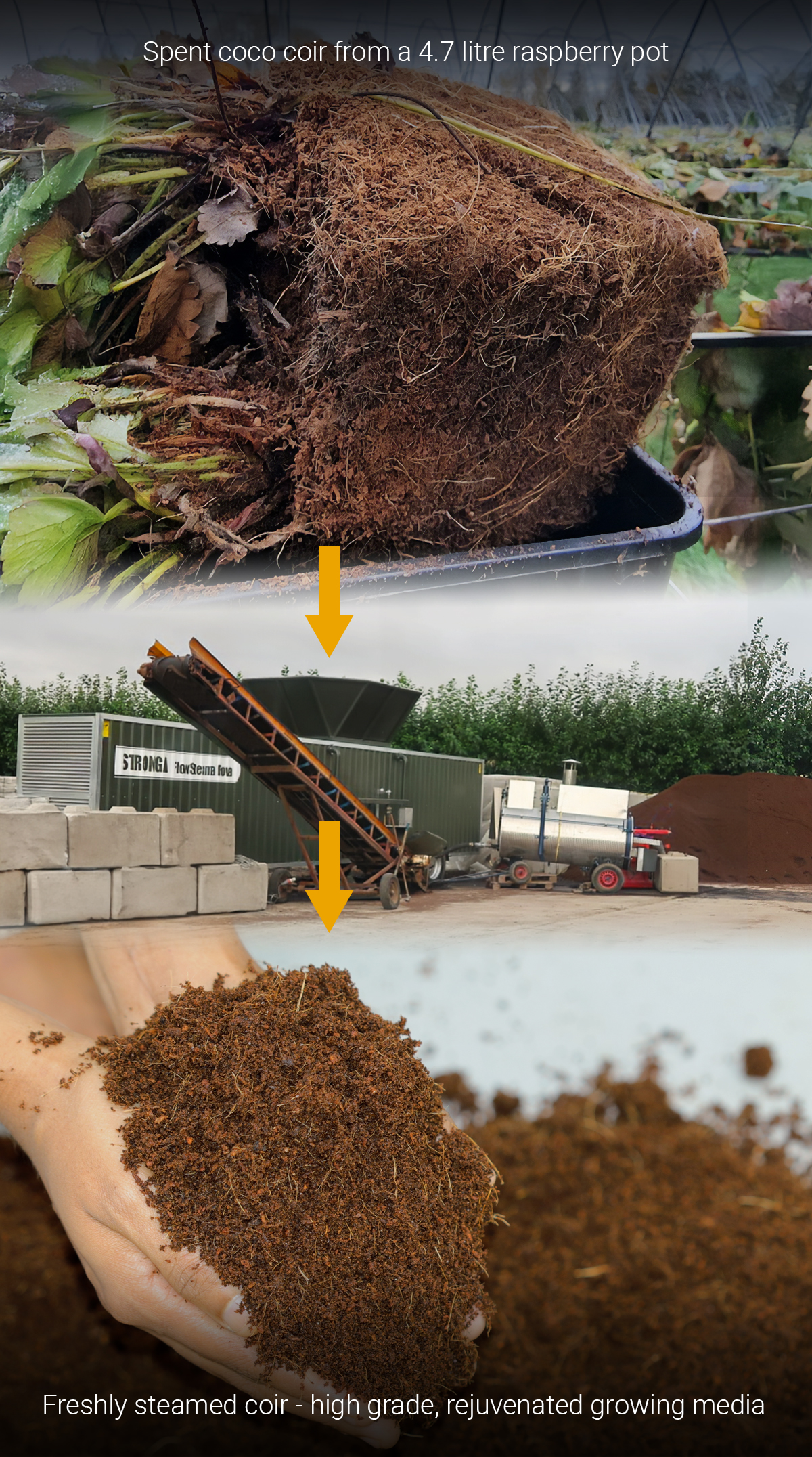
Freshly steamed coco-coir discharged from the FlowSteama vessel is full of organic nutrients and microbes.
Boosting Substrate Quality, Enhancing Microbial Balance, & Increasing Nutrient Availability
FlowSteama helps reduce waste in the horticultural sector, producing sustainable growing media and creating closed-loop resource recovery by repurposing spent substrates.
1. Differences in Survival Structures
Beneficial microbes such as many Bacillus species, Actinobacteria, and certain mycorrhizal fungi commonly produce heat-resistant survival structures (spores, cysts, sclerotia). These enable them to withstand steam pasteurisation far more effectively than most vegetative pathogenic organisms.
By contrast, soil-borne pathogens such as Pythium, Rhizoctonia, Fusarium, and many nematodes typically depend on vegetative hyphae, oospores, or relatively fragile resting structures. These are found in growing substrates and soils and are much less resistant to the 60–90°C temperature profile created during low-pressure flow steaming. While temperatures at the steam injection point may approach approximately 200°C, much of the soil matrix rarely exceeds 80–100°C, leaving beneficial survival forms with a clear advantage over harmful pathogens.
2. Colonisation Speed & Ecological Strategy
Beneficial organisms tend to follow R-strategist strategies: they colonise rapidly, grow quickly, and disperse efficiently via spores or airborne inoculum. They readily recolonise soil from untreated pockets, organic amendments, or airborne deposition. Alternately, many soil pathogen’s function as K-strategists. They colonise more slowly, often requiring the presence of a host plant to proliferate. As a result, their re-establishment after steaming typically lags behind that of beneficial organisms.
3. Sources of Re-Inoculation
Beneficial microbes recolonise quickly through multiple pathways:
• Airborne dispersal of spores and bacteria (e.g. Bacillus, Trichoderma).
• Water inputs such as irrigation that carry beneficial inocula.
• Soil fauna activity, including earthworms and insects, which transport microbial propagules.
In contrast, pathogens generally require a host plant or infected residues to re-establish, meaning they do not re-enter growing substrates from the air or water at the same rate as beneficial organisms.
4. Soil Chemistry After Steaming
Steaming alters soil chemistry by releasing ammonium (NH₄⁺), soluble organic compounds, and by shifting the redox environment (how much oxygen is available for microbes). This creates a nutrient flush that strongly favours fast-growing saprophytes. Beneficial decomposers are well adapted to exploit this sudden resource availability, whereas most pathogens are specialised for parasitism and are less competitive under nutrient-rich, host-free conditions.
5. Competitive Interactions
Early-arriving beneficial microbes such as Trichoderma and Bacillus not only recolonise quickly but also actively suppress pathogens. They do so through mechanisms like antibiosis, enzyme secretion, and competitive exclusion. This rapid establishment of a suppressive microbiome helps stabilise the soil/substrate community in favour of beneficial organisms, slowing or preventing pathogen resurgence.
6. Practical Implication
These dynamics explain why steaming or bio-fumigation is often paired with re-inoculation practices. Adding beneficial inoculants, compost teas, or mycorrhizal fungi immediately after treatment helps bias the recolonisation trajectory toward suppressive, plant-friendly microbial communities, reducing the window of opportunity for harmful pathogens to re-establish.
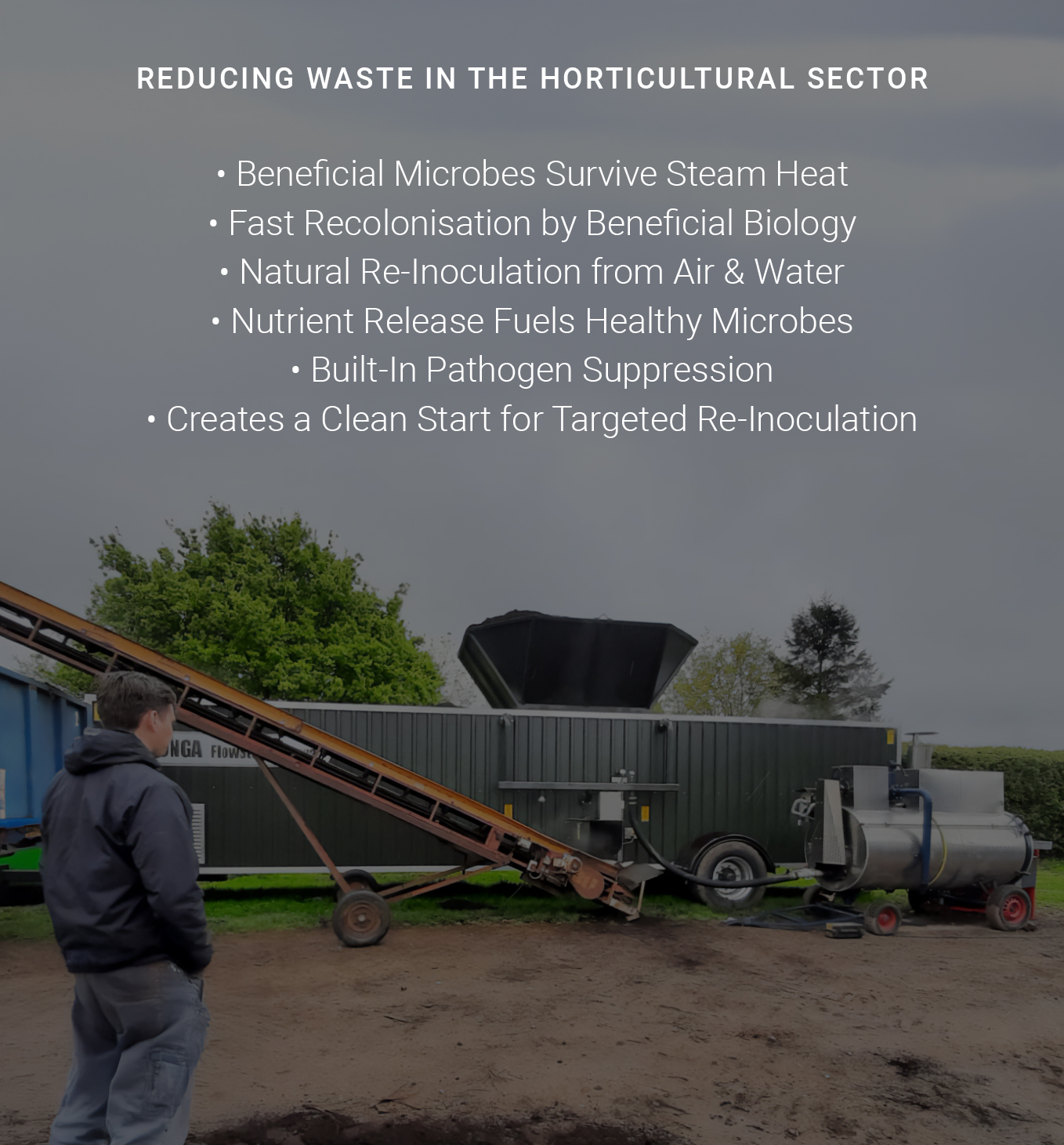
Benefits of Steam-Treated, End-of-Season, Composted Coir on Soft Fruit Plants
Coir is becoming an increasingly scarce resource. FlowSteama eliminates import demand and single-use purchasing costs, instead allowing growers to achieve multiple seasons’ use from recycled, steam pasteurised growing media. Discover the benefits of steam treating coco coir.
1. Faster & Bigger Root Growth
Steam-treated spent substrates create a clean, pathogen-free media that allows roots to expand rapidly without early stress, or waterlogging and root rot. With harmful organisms suppressed and beneficial microbes thriving, roots are well-aerated, experience less competition and more bioavailable nutrient flush. This leads to faster root initiation, deeper penetration, and a more extensive root mass, giving plants a stronger foundation and increased resilience throughout their lifecycle. Strong root growth leads to healthy and faster plant growth, higher yielding and higher quality and flavour.
2. Better Nutrient Uptake (More Nutrient Availability)
Steaming releases bound nutrients, increases ammonium availability (NH₄⁺), and stimulates the breakdown of organic matter into plant-ready forms. Beneficial microbes recolonising the soil further enhance nutrient cycling. As a result, plants experience superior nutrient flush uptake efficiency, improving growth rates, foliage development, and overall metabolism. Higher cation exchange capacity retains nutrients in the root zone, minimising leaching and improving uptake efficiency.
3. Enhanced Water Retention
Coir’s fibrous matrix holds moisture while maintaining air-filled porosity, reducing irrigation demand and protecting plants during dry periods.
4. More Nodes per Plant
With improved root systems, enhanced nutrient availability, and reduced pathogen stress, plants can focus on healthy structural growth. This leads to increased node formation which boosts branching potential, flower sites, and overall productivity. More nodes directly correlate to higher yields and stronger plant architecture.
5. Bigger, Healthier & Stronger Plants
The combined effects of pathogen suppression, superior nutrient access, and a thriving beneficial microbiome produce larger, more vigorous plants. These plants demonstrate stronger stems, greater leaf area, and faster biomass accumulation — key indicators of optimal plant performance.
6. More Fruiting, Higher Yield, Higher Crop – Bigger Profits
When plants experience minimal disease pressure and maximal nutrient availability, they can redirect their energy toward reproduction and increase crop production. This results in:
• Earlier fruiting, early seasons crops, increasing profit potential
• Increased fruit sets
• Higher total yields (200% increase)
• Extended fruiting seasons
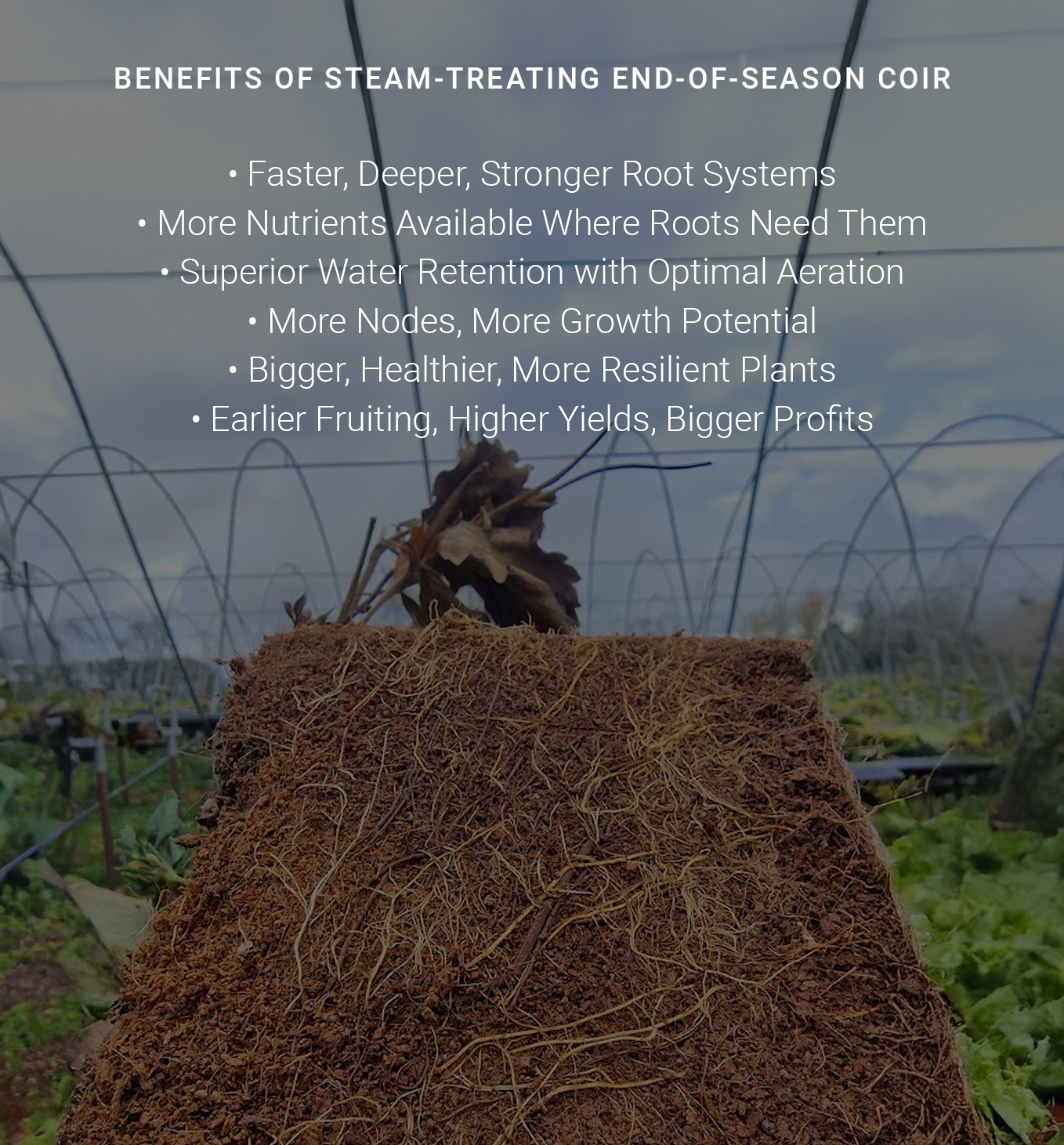
Investing in FlowSteama equipment, professional growers gain more marketable produce, spread over a longer season, with improved reliability and consistency.
DOUBLE THE FRUIT YIELD… What is that worth to you?

Propagation trays using recycled, steam pasteurised coir growing substrates.
1. Better Quality
Healthier plants grown in balanced, microbially active substrates naturally produce higher-quality products — brighter colours, improved flavour profiles, enhanced aromas, and greater uniformity. Reduced stress leads to more stable growth patterns and better premium-grade harvests.
2. Bigger Fruit
Steam-treated soils/substrates deliver strong nutrient uptake and optimal plant energy allocation, leading to larger fruit size, improved cell expansion, and better fruit density. Bigger fruits have better market value and stronger consumer appeal.
3. Healthier Plants
By suppressing soil-borne pathogens and encouraging beneficial microbial dominance, steam treatment creates a naturally disease-resistant growing environment. Plants experience fewer infections, reduced root stress, and increased immune responses, allowing them to maintain growth even in challenging weather conditions and environmental stresses.
4. Healthier Substrate/Soil Biome
Steamed substrates reset the soil ecosystem in favour of beneficial organisms that recolonise quickly and efficiently. This results in a balanced, resilient, and productive biome, improving structure, nutrient cycling, and long-term substrate and plant health. Over time, homogenous media leads to more predictable irrigation, consistent crop performance and reduced soil/substrate fatigue. This enhances workability and resilience of soils, particularly in light or degraded substrates used in soft fruit systems.
5. Less Chemicals
Because clean steam treatment effectively suppresses pathogens and promotes natural microbial competition, growers can significantly reduce or eliminate chemical fumigants, pesticides, and disease-control inputs. This lowers operational costs, improves environmental sustainability, and supports cleaner, safer production systems that align with modern organic, market demands.
6. Increased Production Efficiency
FlowSteama allows substrates (coir, peat etc.) to be safely reused by eliminating pathogens, weed seeds and pests, restoring a clean and consistent premium growing medium, reducing costs and waste, improving sustainability, and supporting stronger plant growth with a healthier microbial balance, significantly increasing profits.
7. Reduced Transport/Import Costs
By creating a closed-loop resource recovery system, growers using FlowSteama remove the need for repeat, single-use coir imports, container imports, removing freight, port and haulage costs.
The Business Case
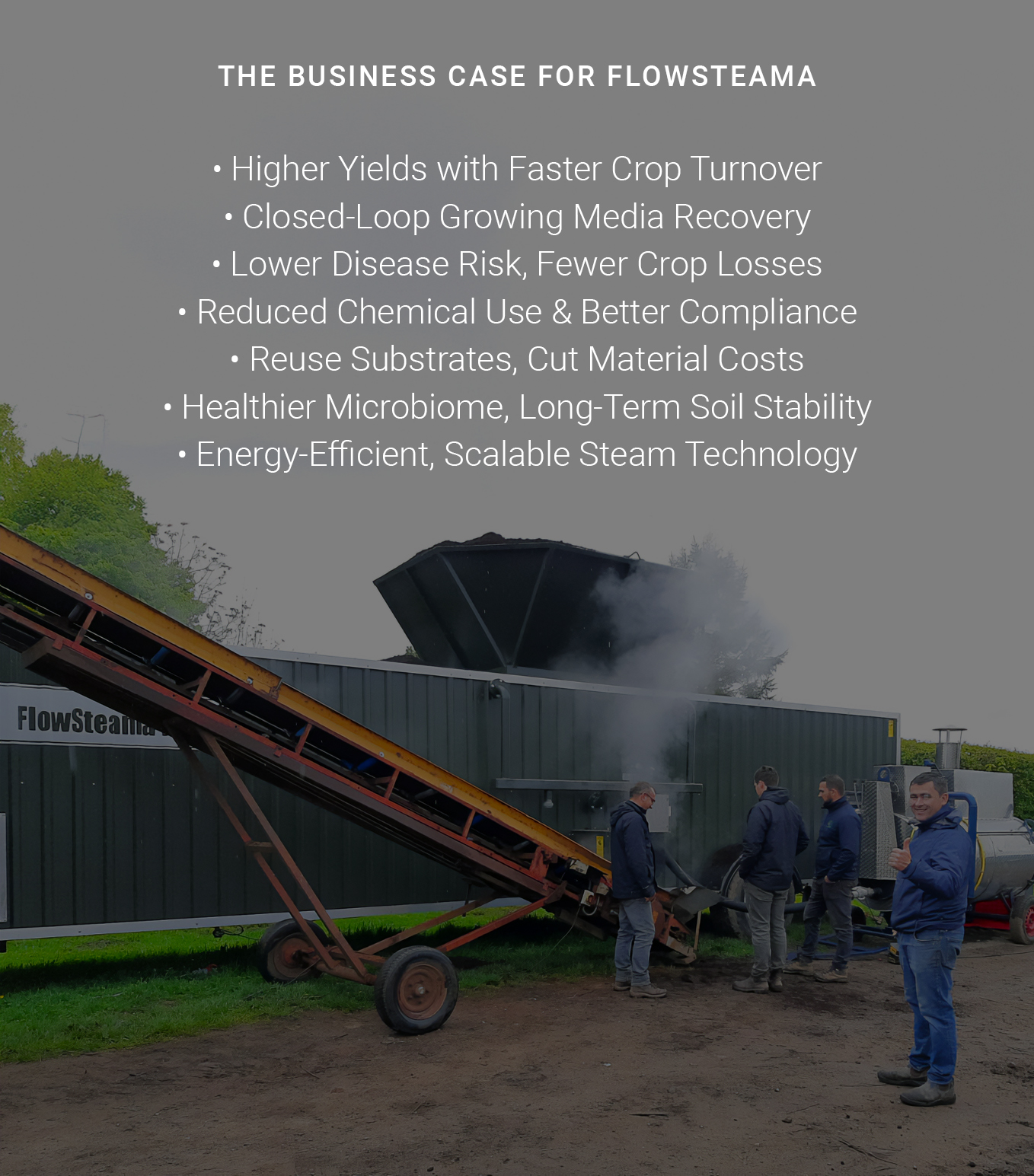
FlowSteama and SteamBoila offer a low pressure, super-heated 200’C steam pasteurisation solution that not only enables the recycling of spent growing substrates and root balls, but also provides an effective method of pathogen, pest and weed control. PulseWave™ agitation in the FlowSteama vessel ensures all particles are exposed to the super-heated steam, while precise time-at-temperature controls allow operators to control and monitor substrate target temperature requirements. The business case is compelling.
1. Higher Crop Yields & Faster Turnover; Steam-treated substrates support rapid plant establishment, stronger early root development, and improved nutrient uptake due to a healthier, beneficial-microbe–dominant microbiome.
2. Reduce Waste Within the Horticulture Sector; FlowSteama enables closed loop resource recovery by repurposing sustainable, spent growing (coir, peat etc.) medium.
3. Reduced Pathogen Losses & Lower Crop Failure Risk; Reduction in risk of crop failure, a significant value driver. Particularly for high-density greenhouse or vertical (soft fruit) farming operations where disease spreads rapidly.
4. Lower Chemical Input Costs & Regulatory Compliance; Financial savings on chemical products and repeat purchases, reduced sprayer labour costs, elimination of re-entry intervals, compliance with chemical/fumigants regulations, marketable sustainable benefits.
5. Reusability of Substrates & Lower Material Costs; Significant reduction in single use substrate purchasing costs (circa 80%), lower input costs, longer season’s use of rejuvenated growing media.
6. Improved Microbiome Balance for Long-Term Soil Health; The natural recolonisation advantage of beneficial microbes after steaming leads to stable, suppressive soil environments, long term yield stability and reduced cumulative pathogen pressure. Steaming soil and growing substrates builds a biological asset, better nutrient cycling and higher resilience under stress.
7. Energy Efficiency & Operational Scalability with Stronga Technology; Lower labour requirements, higher throughput and lower energy cost per cubic meter treated, FlowSteama is optimised for your pasteurisation project.
Steam treatment with FlowSteama, allows growers to reuse coir as well as other substrates, instead of replacing it every cycle — offsetting up to 80% of material and shipping costs. A win-win for growers.
The Financial Case for Steam Pasteurising Coir with FlowSteama
The financial case for steam-pasteurising coir rather than continuous annual purchasing single-use material is compelling; Growers can save 80% of their coir purchasing costs each year. Beyond the substantial cost savings outlined in the table below, coir is becoming increasingly scarce. With reduced availability, FlowSteama empowers growers to reclaim and reuse spent substrate. This sets your growing operation apart, giving you a unique and competitive advantage. Overall, FlowSteama often allows growers to achieve return on investment in the first season.
The table below outlines an example of a project-specific economic assessment, illustrating how the FlowSteama can deliver significant financial savings when compared to the costs associated with purchasing single-use coir substrate – all values are indicative only and are based on an estimated raw coir price of £40/m₃.
| Category | Value | Commercial Impact (Project Specific) |
| Annual operating hours | 1,000 hrs | Actual operating hours vary by available material, crop cycles, and farm operations. |
| Annual throughput | 8,000 m³ | Similar to the above, varies with grower scale of operations. |
| Annual gross cost savings substrate only | £256,000 | Based on reusing 6,400 m³ of coir (80% of 8,000 m³) at an avoided re-purchase cost of £40/m³. |
| Fuel Cost | £11,200 | Fuel costs estimated at 2 L/m³ at £0.70/L →£1.40/m³. *Actual consumption depends on bulk density and moisture content. |
| Labour Cost | £20,000 | Operator cost (1000hrs) estimated at £20/hr. |
| Net annual benefit… EVERY YEAR | £224,800 | Annual substrate purchase saving. |
| Estimated CAPEX | £100,000 | FlowSteama and SteamBoila capital investment dependent on project specific parameters. Precise cost calculations on enquiry. |
| Payback Period | 5 months | Based on £100,000 CAPEX and £224,800 net annual saving. Payback within one growing season; actual payback depends on throughput and operating conditions. *Payback excluding double of fruit growing. |
* Please note these are estimated financial savings. For bespoke advice about your steam pasteurisation requirements – contact Stronga. The final configuration and economic benefits are always calculated on a project-specific basis and depend on your project parameters.
High-Performance Steam Heat-Treatment Solutions
Steam treatment solutions from Stronga offer a sustainable and unique solution for optimising and recycling growing substrates. By combining precise temperature control with efficient energy use, the FlowSteama approach not only controls and limits harmful pathogens but also creates ideal conditions for beneficial microbes to thrive. The result is healthier soils and substrates, stronger crops, and a more resilient growing operation. Ultimately, steam heat treatment is more than a process — it is an investment in unlocking nature’s full potential for long-term growing productivity and sustainability.
Unlock the full power of steam for healthier substrates, stronger crops, and cost savings with FlowSteama. Contact Stronga today and discover how our steam technology can transform your growing operation – enquiries@stronga.com



Share this post